 |
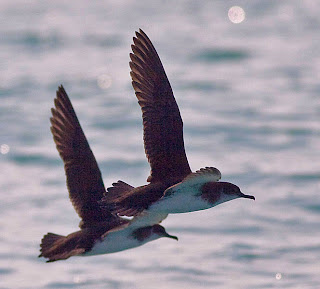
| This amazing image of two Manx Shearwaters flying side-by-side was taken by Nick Hatch at Icy Bay, Alaska on August 4, 2009. (Click photo for larger view.) |
This may be the first photographic evidence of Manx Shearwaters in Alaska. Information I received from Steve Heinl in Ketchikan was that "People have been seeing Manx Shearwaters in the NE Gulf of Alaska in small numbers for the past 5 years or so."
Steve Mlodinow wrote a status article "Manx Shearwaters in the North Pacific Ocean" in
Birding, December 2004, pp. 608-615. Mlodinow followed that up with a Letter to the Editor in
Birding, August 2005 (Vol 37, Number 4, pp. 348-349). In this letter he wrote that nest-site prospecting was suspected on Triangle Island, BC, in 1994. Nocturnal voice recording surveys at a seabird colony there in July of that year recorded calls that were consistent with Manx Shearwater. They were "regularly" encountered on at-sea surveys off British Columbia in summer 2004 according to Ken Morgan.
 |
| Manx Shearwater by Nick Hatch, Icy Bay, Alaska, August 4, 2009. |
Manx Shearwaters began appearing regularly off California in the 1990's (12 reports from California and Washington in 1994). It is no longer a Review species in California, with over 100 accepted records.
Oregon's first reported Manx Shearwater was in October 1998. Oregon's first record accepted by the Oregon Bird Records Committee (OBRC) was in September 2000. Most Oregon reports are from seawatch sites on shore where birds are rather distant and photos are difficult to obtain. Nevertheless, there are now 3 at-sea photographs of Manx Shearwaters in Oregon waters (see
Oregon Rare Bird Photos). There are 6 accepted records of Manx Shearwaters by the OBRC through September 2006. However, there were 43 reported sightings of Manx Shearwaters through 2006, and another 27 reports of undifferentiated Manx/Black-vented type shearwaters from 1976-2006. Since then, reports have increased. [Many reports are not submitted to the OBRC, for various reasons that are not the subject of this post.]
|

| Copy of March 1, 2008, Manx Shearwater report to OBRC by Greg Gillson. |
Manx Shearwater reports from Oregon for the past decade have averaged over 6 birds per year. There have been an additional 25 (2.5 per year average) unidentified Manx/Black-vented Shearwaters reported during this time. There are 10 total Oregon reports of definite Black-vented Shearwaters, 4 accepted by the OBRC. So the unidentified small black-and-white shearwaters can't be assumed to be one or the other species.
Of the 64 reported Manx Shearwaters in Oregon, 30 have been April-June, while 23 have been September-November. Though some birds have been reported in summer, there seems to be definite spring and fall migration peaks. Oregon reports to date range from March 1 to December 5. [See a compilation of reports on
Rare Seabirds of Oregon.]


