Showing posts with label status and distribution. Show all posts

Tuesday, May 22, 2012

Increasing seabirds in Gulf of Alaska and decreasing in Southern California?

An interesting article appears on the Marine Ecology Progress Series in the article: Phenology of pelagic seabird abundance relative to marine climate change in the Alaska Gyre by Thompson SA, Sydeman WJ, Santora JA, Morgan KH, Crawford W, Burrows MT (2012).

Part of the abstract states:
Overall, 5 species showed no change, 1 declined, and 9 species as well as all species combined showed increasing abundance. By season, 3 species increased in winter, 7 in late spring, and 6 in late summer. Eight of 15 species showed relationships with our environmental index. Increases in seasonal seabird abundance may be related to lengthening of the ‘growing season’, as demonstrated by temporal temperature shifts and expansion of peak chlorophyll concentrations. Seabirds of the Alaska Gyre are probably responding to changes in forage nekton that are related to this extended growing season by shifting their migration to later dates.
The full text appears in a pdf link. This is one study of several that may point to a redistribution of seabirds (abundance and diversity). It appears there is a trend for fewer seabirds in the Southern California Bight and more birds for a longer portion of the year in the SE Gulf of Alaska.

Saturday, May 12, 2012

Oregon pelagic birds: Horned Puffin

pelagic birds


On our May 5th trip we found a Horned Puffin, one of Oregon's rarer pelagic birds, 28 miles off Newport. The bird we found is my photo above. How rare is it? We've run almost 150 pelagic trips since 1994 and this was only the 5th time we've spotted this bird. That's about 3.3%

The Handbook of Oregon Birds (2009) by Herlyn and Contreras has this to say: "Rare to sometimes abundant visitor to the offshore waters of the [northeast] Pacific.... occasionally seen onshore in winter and spring." So, far offshore larger numbers of birds may occur in certain years. But the birds generally occur farther offshore than most traditional pelagic trips, and at seasons where there are fewer pelagic trips scheduled. You might say that the bird itself might not be all that rare in Oregon's offshore waters, but it is rarely seen.

However, also occasionally, a Horned Puffin will be found in summer amid breeding Tufted Puffins on the Oregon coast, but they do not breed in Oregon. So if you wait long enough, and do lots of seawatches, you will possibly see one of these birds from shore in Oregon.

Here, then, are the details of our sightings on our boat tours:
  • April 4, 1998, on a 20-hour trip where we got on the boat at night and were 60 miles offshore from Depoe Bay at dawn, we encountered 2 birds.
  • March 27, 2007 we encountered 7 live and 2 dead Horned Puffins 15-33 miles offshore from Newport. This followed unprecedented numbers of dead puffins (150+) washing up on Oregon's beaches during the winter/spring.
  • August 16, 2008 there was a bird just off the jetties at Newport.
  • February 21, 2009 a couple of people spotted a bird flying away from the boat about 8 miles offshore.
  • May 5, 2012 one bird 28 miles offshore from Newport.
So it is possible to see Horned Puffins on winter or spring pelagic trips from Oregon, especially if the trips travel well beyond 30 miles from shore. But it's not very likely. This species remains one of Oregon's rarer pelagic birds.

Tuesday, April 10, 2012

A final five common Oregon sea birds

Previously we discussed 10 other common birds:
Five common Oregon sea birds and
Five more common Oregon sea birds.

Here are a final five common Oregon sea birds. These are by no means the only birds you will see on a pelagic trip. Rather, you should expect to see most of the 15 species presented in these 3 articles on nearly every trip! It is not unusual for first-time pelagic participants to see a dozen life birds--birds they have never seen before.


Oregon sea birds: Pink-footed Shearwater
Pink-footed Shearwaters are rather common, arriving in spring and remaining until winter. At times they approach within a mile of shore--especially early in the morning--but are usually found 5 to 30 miles offshore.


Oregon sea birds: Fork-tailed Storm-Petrel
Fork-tailed Storm-Petrels are found spring through fall. They nest along the Oregon coast on offshore islands. They remain in their nest burrows during the day, and only come and go at night, spending several days far offshore before returning to their nestling. Thus, very few people have seen these birds from shore. On our trips they are found from 10-55 miles offshore.


Oregon sea birds: Parasitic Jaeger
Parasitic Jaegers are loners, harassing gulls and terns to steal a meal. This is the jaeger most likely to be seen from shore, especially in the fall when they may mercilessly chase small gulls, terns, or shorebirds just offshore before winging back out to sea. These can be found 50 miles offshore in migration, but are most likely to be found within 20 miles of shore.


Oregon sea birds: Common Murre
Common Murres nest abundantly on the Oregon coast. In summer they fly back and forth from their nest colonies--bringing a single fish to their lone nestling--where thousands of birds nest shoulder to shoulder on the tops of flat offshore sea stacks. They are usually found within 8 miles of shore, but in winter can be found out much farther. Most visiting birders to the Oregon coast have seen this species from shore.


Oregon sea birds: Rhinoceros Auklet
Rhinoceros Auklets are on the target list of visiting birders to the Oregon coast. These birds are found on nearly every trip from nearshore off about 20 miles or so. From certain headland locations with a powerful spotting scope you may see these birds from land. But these glimpses of distant birds bobbing on the water or flying away are rarely as good as the views on a pelagic trip.

Come and see the interesting Oregon sea birds found offshore. Visit The Bird Guide's pelagic birding web pages to reserve your spot to view Oregon sea birds.

Thursday, April 5, 2012

Five more common Oregon sea birds

Here are five more common Oregon sea birds that you will very likely see on your next pelagic trip.

Previous article: (Five common Oregon sea birds)
 
Oregon sea bird: Northern FulmarNorthern Fulmars are gull-like tubenosed sea birds. They are common from early fall to early spring. Though sometimes seen from shore in late fall, they are most often encountered more than 20 miles offshore with the albatrosses.

Oregon sea bird: Sooty ShearwaterSooty Shearwaters are Oregon's most abundant sea bird. They arrive in March and remain through October. They may sometimes be seen feeding on bait fish near shore and from shore, even within the mouth of the Columbia River. Usually, however, most birds are between 5 and 20 miles from shore.

Oregon sea bird: Pomarine JaegerPomarine Jaegers are the most frequently seen of Oregon's jaegers. They are common spring and fall migrants. Often seen singly, they are most common from 10-25 miles offshore, where they harass smaller birds into giving up their most recent meal.

Oregon sea bird: Arctic TernArctic Terns migrate far offshore, usually over 20 miles from shore to hundreds of miles offshore. This keeps them out beyond most of the bigger Pomarine Jaegers and gulls. They are rather rare in late spring, and uncommon from July to mid-September.

Oregon sea bird: Cassin's AukletCassin's Auklets are found from near shore to about 25 miles offshore. A few nest along the Oregon coast, but they are most common from August through March.

Visit The Bird Guide's pelagic birding web pages to reserve your spot to view sea birds in Oregon.

Thursday, March 29, 2012

Five common Oregon sea birds

What kind of sea birds will you enjoy on your Oregon ocean bird watching tours? Here are five common Oregon sea birds that you can expect to see on your pelagic birding boat trip.

Oregon sea birds: Black-footed Albatross
Black-footed Albatrosses are crowd-pleasers. They soar in on 6-7 foot wing spans and land next to the boat to seek food scraps. They are seen nearly every trip offshore at least 20 miles and are common from March through October.

Oregon sea birds: Buller's Shearwater
Buller's Shearwaters are one of the most beautifully-patterned seabirds. Gliding gracefully over the sea alone, or flapping in amazing synchronized flight in a flock, these are a delight to see. They are only found in the autumn, however, from late August into October.

Oregon sea birds: Red-necked Phalarope
Red-necked Phalaropes are tiny little shorebirds that swim in the ocean! Each spring and fall huge numbers migrate on nearshore waters back and forth from the Arctic tundra, generally within 15 miles of shore. You may see these occasionally on bays and inland ponds, too.

Oregon sea birds: Sabine's Gull
Sabine's Gulls in breeding plumage with black hoods are a joy to see in spring, primarily more than 15 miles offshore. The wing is highly patterned on juveniles coming back from the Arctic in fall.

Oregon sea birds: Pigeon Guillemot
Pigeon Guillemots are nearshore birds, rarely found more than 5 miles offshore. They nest all along the Oregon coast. These are one of the first and last birds you'll see on your pelagic trip, often right near the boat docks.

Visit The Bird Guide's pelagic birding web pages to reserve your spot to view Oregon seabirds.

Wednesday, March 7, 2012

What is the world's smallest shearwater?

Hint #1: It is smaller than the Audubon's Shearwater.

Hint #2: It is littler than the Little Shearwater.

Hint #3: It has been found in the United States.

Hint #4: It was recently described to science.

The world's smallest shearwater is Bryan's Shearwater (Puffinus bryani).

If you haven't heard the story of the Bryan's Shearwater, it bears repeating.

A small shearwater was discovered and collected in 1963 from a nest burrow in a Bonin Petrel colony on Midway Atoll (a territory of the US, midway between Asia and North America, and 1/3 of the way between Honolulu and Tokyo). It was originally identified as the first record for Little Shearwater in the Hawaiian Islands.

Seabirder Peter Pyle recently re-analyzed the specimen trying to determine what subspecies it may be. Instead, he discovered that it was smaller than any Little Shearwater, but colored more like the larger Audubon's Shearwater. Likewise, DNA analysis found that it was closely related to these other shearwater groups, but didn't fit neatly into any one of them. Thus, in 2011 Pyle et al. proposed a new species.

That is interesting in itself. And in over 40 years no other Bryan's Shearwaters were found on well-studied Midway, or anywhere else... until 1997.

During subsequent years, a total of 6 small shearwaters were captured on various islands in the Ogasawara island chain. Just a few weeks after Pyle published his paper naming the new species from Midway, DNA analysis revealed that these Japanese birds were also Bryan's Shearwaters! Japanese scientists believe there may be several hundred birds on these islands. They remained undiscovered so long because these shearwaters evidently breed in winter when seas are unfavorable for visiting these small islands.

Tuesday, October 20, 2009

Manx Shearwater status in Oregon

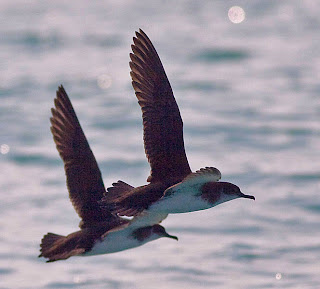
Manx Shearwater. Photo by Nick Hatch. Icy Bay, Alaska. August 4, 2009.
This amazing image of two Manx Shearwaters flying side-by-side was taken by Nick Hatch at Icy Bay, Alaska on August 4, 2009. (Click photo for larger view.)

This may be the first photographic evidence of Manx Shearwaters in Alaska. Information I received from Steve Heinl in Ketchikan was that "People have been seeing Manx Shearwaters in the NE Gulf of Alaska in small numbers for the past 5 years or so."

Steve Mlodinow wrote a status article "Manx Shearwaters in the North Pacific Ocean" in Birding, December 2004, pp. 608-615. Mlodinow followed that up with a Letter to the Editor in Birding, August 2005 (Vol 37, Number 4, pp. 348-349). In this letter he wrote that nest-site prospecting was suspected on Triangle Island, BC, in 1994. Nocturnal voice recording surveys at a seabird colony there in July of that year recorded calls that were consistent with Manx Shearwater. They were "regularly" encountered on at-sea surveys off British Columbia in summer 2004 according to Ken Morgan.

Manx Shearwater. Photo by Nick Hatch. Icy Bay, Alaska. August 4, 2009.
Manx Shearwater by Nick Hatch, Icy Bay, Alaska, August 4, 2009.

Manx Shearwaters began appearing regularly off California in the 1990's (12 reports from California and Washington in 1994). It is no longer a Review species in California, with over 100 accepted records.

Oregon's first reported Manx Shearwater was in October 1998. Oregon's first record accepted by the Oregon Bird Records Committee (OBRC) was in September 2000. Most Oregon reports are from seawatch sites on shore where birds are rather distant and photos are difficult to obtain. Nevertheless, there are now 3 at-sea photographs of Manx Shearwaters in Oregon waters (see Oregon Rare Bird Photos). There are 6 accepted records of Manx Shearwaters by the OBRC through September 2006. However, there were 43 reported sightings of Manx Shearwaters through 2006, and another 27 reports of undifferentiated Manx/Black-vented type shearwaters from 1976-2006. Since then, reports have increased. [Many reports are not submitted to the OBRC, for various reasons that are not the subject of this post.]

Manx Shearwater report to OBRC by Greg Gillson
Copy of March 1, 2008, Manx Shearwater report to OBRC by Greg Gillson.

Manx Shearwater reports from Oregon for the past decade have averaged over 6 birds per year. There have been an additional 25 (2.5 per year average) unidentified Manx/Black-vented Shearwaters reported during this time. There are 10 total Oregon reports of definite Black-vented Shearwaters, 4 accepted by the OBRC. So the unidentified small black-and-white shearwaters can't be assumed to be one or the other species.

Of the 64 reported Manx Shearwaters in Oregon, 30 have been April-June, while 23 have been September-November. Though some birds have been reported in summer, there seems to be definite spring and fall migration peaks. Oregon reports to date range from March 1 to December 5. [See a compilation of reports on Rare Seabirds of Oregon.]